







 Covivio Hotels Revenue Grows 4.7% as European Markets Split
 Lithuanian Apartment Prices Accelerate Across Major Cities
 Georgia's Tourism Revenue Hits Record High
 Norway's Sovereign Fund Commits €1.5bn to European Warehouses
 Market Rout of October 2026: Can Branded Hotels Protect Capital?
 Residential Property Prices in Tbilisi Rise by 5.9% Year-on-Year
Stockholm Industrial Sites Could Become 3,200 Homes
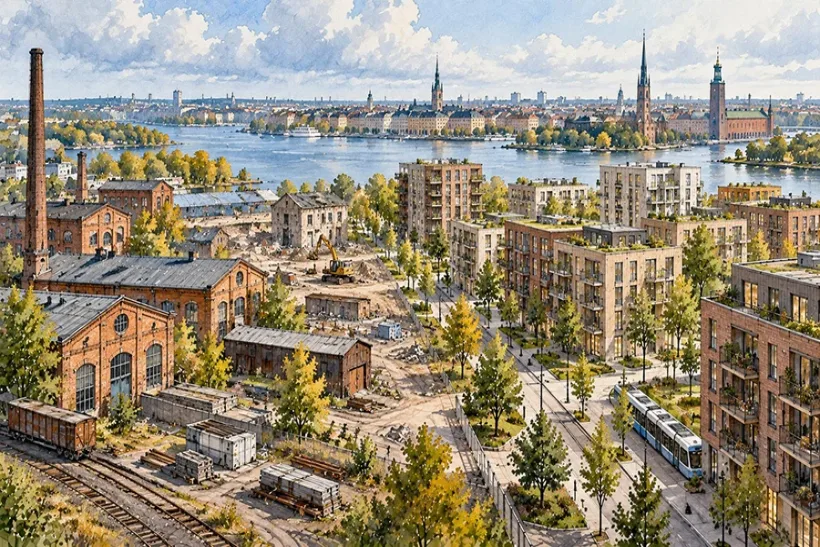
Two former industrial sites in the Stockholm region could eventually accommodate around 3,200 homes. On 16 October 2026, Hines announced the first investment of its European value-add fund HEREP IV, working with local developer Vincero Fastigheter on potential residential redevelopment at Storängen and Segeltorp. The figure describes future capacity, not homes under construction or confirmed delivery dates; closing the transaction itself remains subject to regulatory approvals.
Only two days earlier, Hines and Vastint announced the acquisition of a former glassworks site in Düsseldorf, Germany, with plans for 1,600–1,800 apartments. In both cases, investors hope to turn land already surrounded by urban infrastructure into housing. But planning approvals, utility upgrades and a viable construction budget are still needed before people can move in.
Hines and Vincero target two Stockholm sites
Hines European Real Estate Partners IV's first investment comprises existing industrial assets in Storängen and Segeltorp. Hines says both sites are within walking distance of important bus and rail connections. Vincero Fastigheter is the local residential development partner. The joint strategy is to reposition the properties over time and develop housing in a market where, according to Hines, demand is resilient and supply remains constrained.
The combined 3,200-home figure is an estimate of potential capacity for the two sites, not a breakdown of approved units. Hines has not disclosed a transaction price, land area, construction start date or expected completion timetable. Completion of the investment itself is still subject to regulatory approvals. The 3,200-home figure is an estimate of potential, not an approved construction programme.
HEREP IV attracted more than €500 million of equity commitments at its first close in July 2026, with a target fund size of €1.5 billion. The fund can invest across multiple European property sectors, so neither figure represents the acquisition cost or construction budget of the Stockholm sites. In a value-add strategy, potential gains depend on securing planning approvals, creating a viable residential scheme and managing the time and cost of development.
Sweden's housing recovery is still uneven
Boverket's September 2026 forecast projects around 32,300 housing starts nationwide this year, including 29,900 in new buildings and a net 2,400 from conversions. It expects starts to reach 34,800 in 2027, while completed dwellings are forecast at 29,300 in 2026 and 29,400 in 2027. These are national forecasts for different stages of the housing pipeline, not a schedule for the Hines sites or a comparison of the same homes.
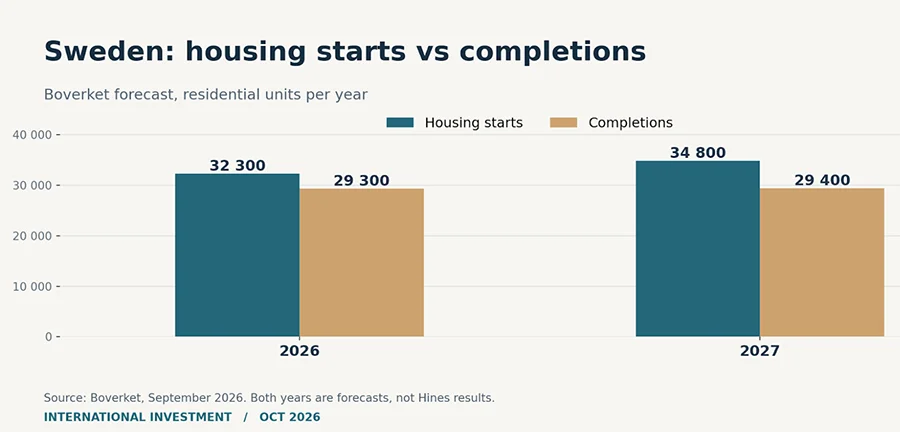
Boverket projects more housing starts than completions in Sweden for 2026–2027. Both measures are nationwide forecasts, not Hines delivery dates.
Housing need is concentrated in particular metropolitan areas and transport corridors, while expensive financing, construction costs and household affordability can constrain project viability. Hines describes Stockholm as a particularly supply-constrained market. Proximity to commuting infrastructure therefore matters at least as much as national construction volume in the investment thesis.
Plans to transform the wider Storängen industrial area in Huddinge municipality date back to 2017. Local utility Stockholm Vatten och Avfall plans new water and sewer infrastructure for the district, with works scheduled to begin in 2029. That is a municipal infrastructure timetable, not a construction start date for the Hines investment. The larger planning area and the two Hines sites have different boundaries, so their potential housing totals and infrastructure costs should not be combined.
Düsseldorf has two similar redevelopment projects
On 14 October, Hines and Vastint announced that their joint venture had acquired the former Glasmacherviertel glassworks site in Düsseldorf-Gerresheim. The approximately 193,000-square-metre location is intended for a new district with 1,600–1,800 apartments, retail, amenities and social infrastructure. Current concepts envisage about 210,000 square metres of gross floor area, at least 80% residential, while preserving three historic buildings.
This is a separate investment partnership, not an additional Stockholm investment by HEREP IV. The factory closed in 2005, and the site has remained largely underused for years. Development is expected in phases, and the project remains subject to planning and approvals. Its long history illustrates why scarce development land does not necessarily translate into prompt housing delivery. International Investment has covered the return of institutional capital to Germany's existing residential portfolios.
Another German example predates these October announcements. In August, Instone and Ginkgo Fund formed a development partnership for Benrather Gärten on a roughly 15-hectare former industrial site, also in Düsseldorf. The proposal includes 800–1,000 dwellings plus social infrastructure, commercial space and green areas. Across the three projects, the major task is the same: prepare industrial land for residential use and coordinate housing with transport, utilities and public services.
|
Project / partners |
Potential homes |
Stage and uncertainty |
|
Stockholm / Hines + Vincero |
About 3,200; two sites |
Rezoning potential; closing subject to approvals |
|
Gerresheim / Hines + Vastint |
1,600–1,800; 19.3 ha |
Industrial site acquired; planning continues |
|
Benrather Gärten / Instone + Ginkgo |
800–1,000; around 15 ha |
Development partnership; delivery pending |
Selected redevelopment proposals, not completed housing. Figures and project stages are not directly comparable. Sources: Hines, Vastint and Instone.
Why urban industrial sites attract capital
Former industrial sites may already have nearby stations, workplaces and utilities — advantages that can be costly to reproduce at the urban fringe. The European Environment Agency calls the reuse of vacant, abandoned or underused urban sites land recycling. It distinguishes this approach from extending development onto agricultural land or open countryside and links it to Europe's objective of limiting net land take.
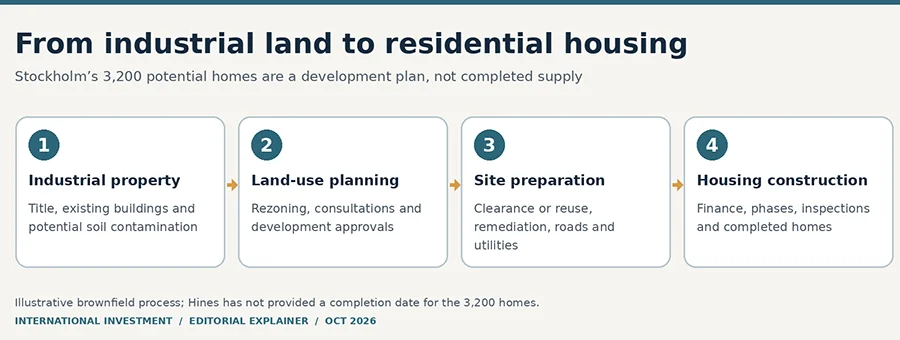
Changing ownership does not make an industrial plot ready for housing. The process may involve rezoning, environmental investigations, soil remediation, noise assessment, new streets, school capacity and upgraded utilities. Local authorities may need to decide whether to preserve industrial buildings or clear the site altogether, and how infrastructure costs will be allocated.
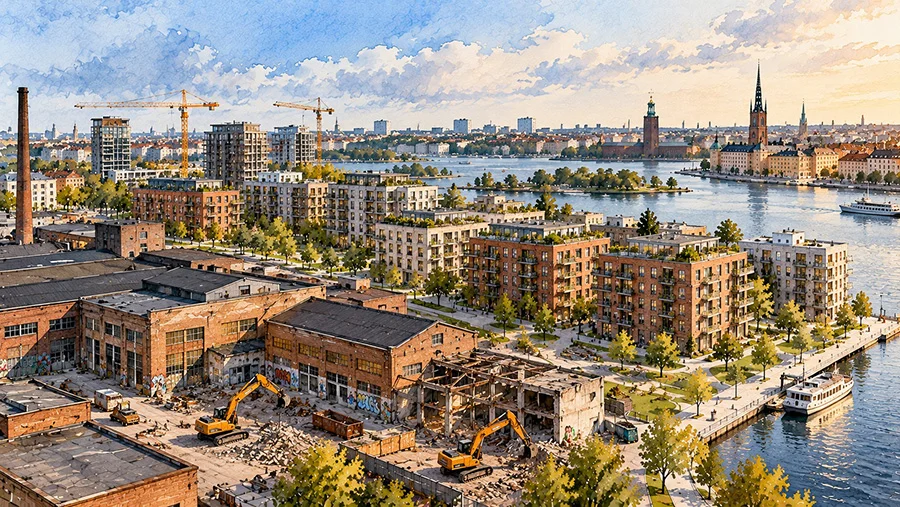
Industrial-to-residential regeneration in an illustrative Stockholm-style district. Editorial artwork, not an architectural visualisation of Storängen or Segeltorp.
These are tangible costs, not generic planning warnings. The wider Storängen area needs new water and drainage infrastructure, while Huddinge municipality's environmental review for Segeltorp identifies contaminated land, traffic noise and stormwater management as redevelopment issues. Both documents concern broader districts, not an approved construction programme for Hines' specific properties.
Higher building costs complicate the investment case
Developing a formerly industrial property is not necessarily cheaper than building on a vacant site. Purchase costs can be followed by remediation, demolition, new utilities, planning fees, borrowing costs and years of delay. A headline home count says little about returns until land, remediation, financing and construction costs have been tested against realistic sales prices or net rents.
JLL's Global Construction Costs Index, published on 15 October 2026, forecasts construction-cost growth of 2.2%–3.5% in Europe during 2027, against a global range of 3.1%–4.2%. Global costs have already risen by an average of 25%–30% over the preceding five years. Those are broad benchmarks rather than a Sweden-specific forecast or an estimate of Hines' construction costs.
Rezoning may increase a site's value, but the developer must still finance site preparation, infrastructure and planning work long before any homes are occupied. A relatively inexpensive industrial purchase may turn into an expensive residential project, while high prices needed for financial viability can reduce the number of households able to buy or rent the finished units.
Illustrative stages of brownfield housing development, from land-use change to completion. Hines has not announced a delivery schedule for its 3,200 potential homes.
Funds take on planning and construction risk
Value-add investors seek returns by changing how assets are used, financed or operated. Brownfield development adds an early-stage land-use component: obtaining permissions and creating a residential scheme that a long-term owner or end buyer can eventually use. The combination of an international fund and a local development partner offers capital alongside knowledge of municipalities, contractors and residential demand.
International Investment has tracked investment recovery in the Nordic markets and total real-estate investment volumes across Europe in the second quarter of 2026. Strong housing demand does not guarantee a profitable development. A project can face costly soil work, longer approvals, expensive debt or demand that is strong in principle but insufficient at the rent or sale price required.
The Stockholm and Düsseldorf cases must therefore be separated by financing vehicle and project stage. A fund-level equity commitment is not an asset acquisition price; a redevelopment concept is not a building permit; and housing potential is not completed supply. The available disclosures do not support a calculation of net development profit or final cost per home for Stockholm.
When new homes could reach the market
Hines and Vincero see potential for around 3,200 dwellings across Storängen and Segeltorp. In Germany, Hines and Vastint are considering 1,600–1,800 apartments on Glasmacherviertel. Both schemes may eventually ease local housing pressure, but their delivery schedules and final unit counts remain subject to procedures that investors cannot skip.
For prospective residents, transport and affordability matter more than the headline size of the development pipeline. In expensive projects, the resulting homes may command rents or prices above what many local households can afford. European authorities are exploring simplification of planning and housing construction rules, but implementation still rests largely with national and municipal decision-makers.
The October investments show how developers are responding to Europe's housing shortage by returning urban industrial land to residential use — without yet adding completed homes. Rezoning, infrastructure and construction may still take years. For both investors and residents, completed homes — rather than theoretical capacity — will be the decisive measure.
FAQ
How many homes could Hines deliver in Stockholm?
Hines and Vincero Fastigheter identify potential for approximately 3,200 homes across Storängen and Segeltorp combined. The company has not provided a completion date or site-by-site allocation.
Has construction begun on the 3,200 homes?
No construction start was announced. The transaction itself is subject to regulatory approvals, and rezoning and development are still prospective.
What is brownfield redevelopment?
It means reusing previously developed, often industrial land for new uses such as housing. It may require planning changes, remediation and major infrastructure investment.
Why do investors buy former industrial land for housing?
Such sites may offer scarce locations near transport and jobs, with value potentially created through rezoning and redevelopment. Planning and cost risk remain significant.
How many apartments are planned at Glasmacherviertel?
Hines and Vastint propose approximately 1,600–1,800 apartments at the former Düsseldorf glassworks, subject to planning and approvals.
How fast are European construction costs rising?
JLL forecasts European construction costs to rise by 2.2%–3.5% in 2027. This does not represent a Stockholm project budget or a Sweden-only projection.
Will industrial-to-residential projects solve Europe's housing shortage?
They can increase supply where urban land is scarce, but planned capacity, construction starts and completed housing are different measures. Affordability depends on final costs and local incomes.