







 Yerevan Real Estate: Rising Prices and the Risk of Overheating
 Cipriani Batumi: Italian Luxury Hospitality Brand Enters Georgia
 Vietnam Real Estate: The Price Boom Gives Way to a Slowdown
 How Much Does Real Estate Cost in Batumi?
 Vienna Hotel Nights Rise as August Revenue Falls
 Investments, New Terminal, and Passenger Growth: Batumi Airport Plans Major Expansion
Georgia Sees Rise in New Construction Projects While Completions Decline
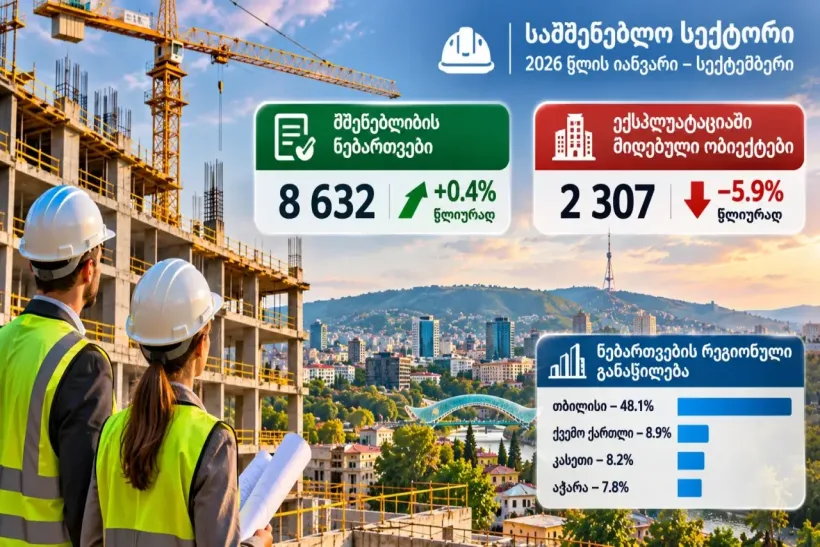
According to data for the first nine months of 2026, construction activity in Georgia showed mixed trends: building permits grew by 0.4% year-on-year, while the number of commissioned facilities dropped by 5.9%. The statistical dynamics highlight a divergence between the launch of new projects and completed construction volumes.
Planning indicators for new projects across Georgia's construction sector continue to grow; however, statistics on completed properties are heading in the opposite direction. According to the National Statistics Office of Georgia (Geostat), 8,632 building permits were issued across the country in January–September 2026, up 0.4% compared to the same period last year.
The issued permits cover the construction of buildings and structures with a total area of 8,654.8 thousand sq m. This indicator highlights the launch of new developments and ongoing market expansion; however, an increase in permits does not automatically mean all planned projects will be completed within the same timeframe.
Construction activity across the country remains heavily concentrated in several key regions. According to Geostat, 48.1% of planned construction work is located in Tbilisi. Among other regions, Kvemo Kartli holds 8.9%, Kakheti represents 8.2%, and the Autonomous Republic of Adjara accounts for 7.8%.
Thus, nearly three-quarters of all building permits are concentrated in four regions of the country, highlighting the geographical concentration of construction activity.
During the reporting period, permits were issued for multi-functional residential complexes, retail properties, hotels, industrial facilities, and agricultural structures. Accordingly, new projects encompass residential, commercial, and industrial infrastructure alike.
At the same time, along with the increase in permits for new construction, the number of completed projects decreased. According to Geostat's report, 2,307 facilities with a total area of 2,543.6 thousand sq m were commissioned in January–September 2026. Compared to the corresponding period of the previous year, the number of commissioned properties fell by 5.9%.
In terms of regional breakdown for completed construction, Tbilisi also holds first place, accounting for 32.5% of commissioned properties. The capital is followed by Mtskheta-Mtianeti with 13.9%, Kakheti with 12.2%, and Kvemo Kartli with 8.6%.
Ultimately, construction statistics for the first nine months of 2026 present a nuanced picture across the sector: new building permits recorded a slight increase, while the volume of completed projects handed over for operation saw a decline. These two indicators form a multifaceted yet interconnected snapshot of current construction market dynamics.