







 Cipriani Batumi: Italian Luxury Hospitality Brand Enters Georgia
 Vietnam Real Estate: The Price Boom Gives Way to a Slowdown
 How Much Does Real Estate Cost in Batumi?
 Vienna Hotel Nights Rise as August Revenue Falls
 Tbilisi to Host International Real Estate Forum Bringing Together Representatives from 16 Countries
 UK Grid Charges Could Rise 25% for Offices
Investments, New Terminal, and Passenger Growth: Batumi Airport Plans Major Expansion
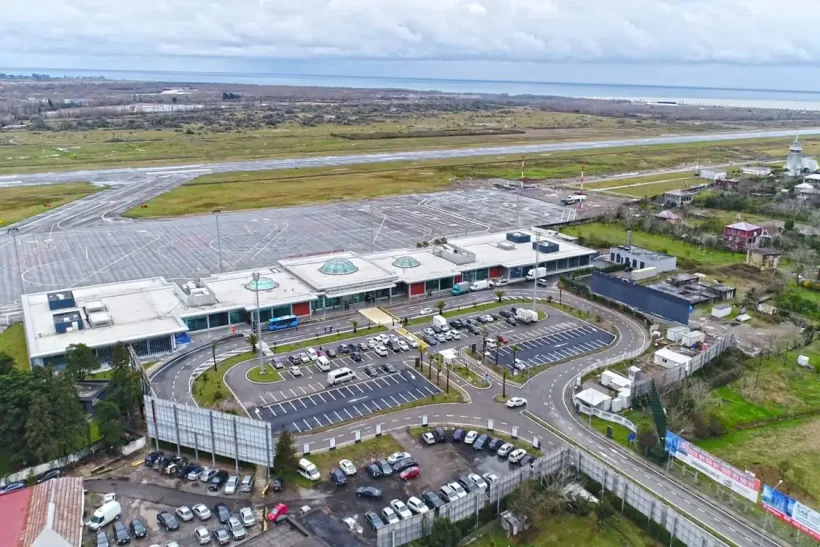
Batumi International Airport is entering a new stage of infrastructure development. Driven by growing passenger traffic, incoming airlines, and new route launches, airport operator TAV Georgia plans to increase passenger handling capacity.
Plans outlined during 2026 encompass two main directions: modernising the existing terminal and raising capacity in the short term, alongside large-scale airport expansion, including the construction of a new terminal, in the long term.
Passenger traffic grows as infrastructure demands extra capacity
Batumi International Airport concluded 2025 with a record performance. For the first time in history, annual passenger volume reached 1 230 200 travelers, which is 29% higher than the 2024 figure.
The upward trend continued into 2026. Specifically, according to TAV Georgia data, Batumi International Airport handled 1 098 027 passengers between January and September 2026. As a result, passenger traffic increased by 10% year-on-year.
As expected, peak activity was recorded during the summer season. From June through September, passenger growth reached 27%. On 13 August, the airport served 11 005 passengers in a single day, setting an all-time daily record.
Air route expansion also played an essential role in driving this trend. In 2026, 11 new destinations and 8 new airlines were added to Batumi Airport's network. October data showed 30 airlines operating flights to 40 destinations from the airport.
These indicators demonstrate that expanding the infrastructure of Batumi Airport is no longer merely a future development prospect; it is driven by the immediate need to meet current demand.
TAV Georgia plans to invest 5 million dollars in Batumi Airport
Under the short-term development plan for the airport, TAV Georgia is investing approximately 5 million US dollars.
According to information shared by company general manager Tea Zakaradze in June 2026, the project aims to expand the active terminal and streamline passenger processing procedures. In particular, the project provides for an additional area of about 1 000 square metres. Thus, the terminal's existing footprint of about 8 000 square metres will increase to 9 000 square metres.
In addition, the project plans include:
-
increasing the number of check-in counters from 14 to 18;
-
increasing passport control booths to five;
-
expanding operational and administrative spaces;
-
arranging around 450 square metres of office space for staff;
-
optimising passenger flow and handling processes.
According to TAV Georgia, the completed works will raise the airport's annual capacity from approximately 1.3 million to 1.7 million passengers. This represents an increase of around 25%, providing the ability to serve an additional 400 000 passengers per year.
Under the company's timeline, Batumi Airport is set to enter 2027 with upgraded infrastructure.
Construction of a new terminal is also being considered
A broader development vision for Batumi Airport was discussed on 19 February 2026 during a working meeting at the Ministry of Economy and Sustainable Development of Georgia. Representatives of TAV Georgia presented a conceptual airport expansion vision to Minister Mariam Kvrivishvili.
The plan outlines both expanding the current terminal and building a new one. The project also covers the development of other critical airport infrastructure.
The meeting brought together representatives from the Ministry of Economy, the Civil Aviation Agency, the United Airports of Georgia, and Sakaeronavigatsia. As a result, the parties agreed to continue working on the airport expansion project.
At this stage, the final investment volume, technical specifications, and specific construction timelines for the new terminal have not been made public. Consequently, this initiative should be viewed as a conceptual direction of development rather than an ongoing construction project.
Airport capacity and Adjara's tourism potential
The need to expand Batumi International Airport is also tied to regional tourism growth.
On 25 June 2026, officials from the Ministry of Economy and Sustainable Development and the Government of Adjara inspected works completed at the airport ahead of the summer tourist season. According to the ministry, an additional 1 000 square metres is being added to the existing terminal area of roughly 8 000 square metres. As a result of completed and ongoing upgrades across multiple areas, overall airport capacity will rise by 22–25%.
Furthermore, government officials emphasized the significance of the upcoming Eagle Hills project in Adjara in connection with airport development. According to ministry estimates, this project will create a new regional hub of attraction and help transform Adjara into a year-round travel destination. This, in turn, could trigger further growth in international flights and passenger numbers.
However, when assessing long-term demand, it is essential to consider not only the rising number of new hotels and tourist facilities, but also their actual occupancy rates, mitigation of seasonality, and capacity to attract foreign travelers.
What could airport expansion change in the investment environment?
Increasing the capacity of Batumi International Airport can benefit the regional economy across several key areas. Specifically:
Tourism and hospitality - additional flights and expanded passenger handling capabilities will enhance Batumi's accessibility for international visitors. This is especially vital for the hospitality sector and tourism services.
Real estate - improved international transport connectivity is a key driver enhancing the appeal of investment projects in the region. However, real estate market demand is influenced not just by airport expansion: pricing, supply volumes, tourist occupancy, and the economic sustainability of projects are equally important.
Business ties - new flight routes make Batumi more accessible to foreign investors, business travelers, and international partners.
Employment and services - airport expansion and growing passenger flows generate supplementary demand for transport, catering, retail, and related services.
At the same time, the effectiveness of infrastructure expansion will depend on the balanced, coordinated development of the airport itself, regional transit links, and the tourism industry.
The next phase of Batumi Airport's development
As of 2026, Batumi International Airport's development process addresses two interconnected priorities: providing high-standard service amid growing passenger traffic and expanding the airport's infrastructure capacity over the long term.
A 5 million dollar investment project and the objective of raising annual capacity to 1.7 million passengers form an integral part of short-term progress. Meanwhile, the conceptual plan for a new terminal illustrates that airport expansion may evolve into an even larger investment campaign.
The continued development of Batumi International Airport will become a defining factor not only for the aviation sector, but for the entire tourism and investment climate of Adjara. The final outcome will be determined by the delivery timelines of planned investments, the sustainability of new flight routes, and the tangible impact of infrastructure upgrades on regional travel demand.