







read also
 Asunción Property Market Accelerates as Construction Booms
 Egypt Expands Aviation for Tourism Growth
 Latvia’s Residence Permits for Real Estate to Be Abolished from September 15
 Egypt Prepares New Law for Property Developers
 Young Japanese Buyers Turn to 50-Year Mortgages
 Argentina Narrows Tourism Gap as Arrivals Rise
Real Estate / Tourism & hospitality / Analytics / Research / Reviews / News / Iceland / Real Estate Iceland 30.03.2026
Iceland's Real Estate Market in 2026: Prices Rise Slowly, 74% of Properties Sold at a Discount
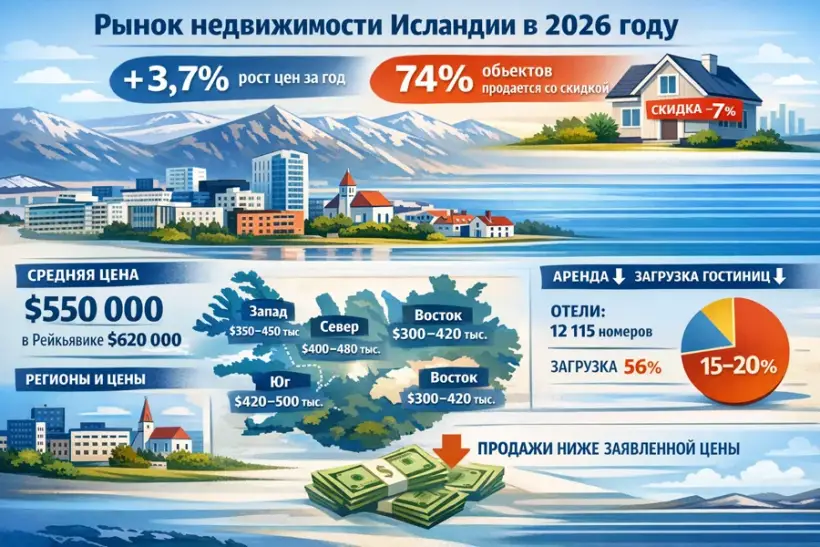
At the beginning of 2026, Iceland’s real estate market shows signs of cooling after several years of rapid price growth and demand exceeding supply.
Price Trends
In January 2026, housing prices increased by 3.7% year-on-year (compared to January 2025). For comparison, in previous years, growth rates reached double digits – 10% and higher. Thus, the market continues to grow formally, but the pace of price increases has slowed several times over.
Around 74% of properties in 2026 were sold below the initial asking price. Sellers overestimate expectations but concede during negotiations. The average discount is 6-7%.
However, if the average price in 2025 was about $540,000, a sale at $560,000 represents the 3.7% year-on-year growth despite the discount, reports RUV.
One of the Most Expensive Markets in Europe
The average housing price in Iceland is $550,000. In the Reykjavík metropolitan area, it reaches $620,000. Private houses are usually sold for more than $1,000,000.
High prices persist due to limited supply and population concentration in the Reykjavík area. Even with lower buyer activity, this supports the market from falling.
At the beginning of 2026, rental rates declined despite rising housing prices, indicating weakening rental demand and increasing supply, reports Iceland Monitor.
Local Markets
Capital Region (Reykjavík and suburbs): Traditionally accounts for 65-70% of the real estate market. The average transaction price in Reykjavík in 2026 is $620,000. Annual price growth: 3-4%.
Southwest (Keflavík and the international airport area): Average price: $450,000–$520,000. Yearly growth: 2-4%.
South (Selfoss and surrounding areas): Average price: $420,000–$500,000. Growth: 2-3%.
West and Westfjords: Price: $350,000–$450,000. Growth: 2-3%. The market is characterized by low liquidity.
North (Akureyri): Price: $400,000–$480,000. Growth: 3%.
East: Price: $300,000–$420,000. Growth: 1-3%. Up to 80% of deals sold at a discount. The weakest region in terms of demand. Key indicators in the capital region exceed those in the East by 1.5–2 times, notes Islandsbanki.
Economy Overview
Overall inflation is 5.2% year-on-year. Housing-related expenses rise faster – about 7.2% per year.
This directly affects the market: mortgage payments increase, housing affordability declines, and buyer activity drops.
This does not mean the market is falling, but growth is no longer at previous rates. 2026 establishes a new equilibrium where high housing prices persist, but transaction conditions become significantly tougher for sellers.
Icelandic Tourism
Iceland has a small population – about 400,000 residents. Therefore, investment properties aimed at generating income from tourism occupy a significant part of the housing market.
Direct tourism contribution to GDP in 2025 was approximately 10-12%. Including indirect effects (transport, restaurants, retail, construction services related to infrastructure), the tourism-dependent share of the economy is estimated at 15-20% of GDP.
In 2025, tourism generated revenue of $1.6–1.7 billion. The tourism sector employed 25,000–30,000 people – 8-10% of the total working population. Including indirect jobs (restaurants, transport, services), this share rises to 15-20%. However, tourist arrivals decreased by 0.4% to 2.3 million, according to IcelandData.
Hotel Real Estate
The average hotel occupancy in Iceland in 2025 was 67% for the year. The country has 173 hotels with a total of 12,115 rooms. In 2025, only four new hotels opened. Together with guesthouses, there are just over 200 properties.
Despite fewer tourists, their length of stay increased by 9.1% in 2025 and by 20% in summer 2025, indicating growing attractiveness of tourism real estate for summer holidays, notes Statistics Iceland.
Iceland does not have a mass market for selling individual hotel rooms as an investment product. Hotels are owned by operators or investment funds. Transactions occur at the asset level, not per room. International chains (e.g., Hilton) operate under classical management, not room resale.
There is no widespread condo-hotel format in Iceland (unlike Dubai or Turkey), nor a market for “buying a room for income.” Reasons: small market (2.3 million tourists) and reaching the tourism capacity ceiling. Therefore, the Icelandic market does not offer private investors passive income opportunities, experts from International Investment conclude.