







 France’s Property Market Slows Ahead of the 2027 Presidential Election
 Yerevan Real Estate: Rising Prices and the Risk of Overheating
 Cipriani Batumi: Italian Luxury Hospitality Brand Enters Georgia
 Vietnam Real Estate: The Price Boom Gives Way to a Slowdown
 How Much Does Real Estate Cost in Batumi?
 Vienna Hotel Nights Rise as August Revenue Falls
How Travel Purposes of Foreign Visitors to Georgia Are Changing: 2026 Trends and Long-Term Dynamics

According to data for the first nine months of 2026, the average monthly number of non-resident visits to Georgia remained virtually unchanged. However, diverging trends can be observed across travel purposes. Visits for holidays and recreation, as well as visiting friends and relatives, are rising, while transit and shopping show a decline. Long-term data reveals that the structure of Georgia's tourism market has shifted significantly compared to the pre-pandemic period.
When assessing Georgia's tourism market, the total number of visits is only one of the key indicators. Equally important is the purpose for which foreign visitors arrive, how their motivation changes, and which segments shape tourist demand.
First Nine Months of 2026: Leisure and Recreation Take the Lead
In the first three quarters of 2026, the largest share of visits was accounted for by travel for holiday, leisure, and recreation.
The monthly average for this category reached 316.3 thousand, which is 2.3% higher compared to the same period in 2025.
Visits to friends and relatives ranked second. The monthly average in this category stood at 143.7 thousand, exceeding the previous year's figure by 2.9%.
A different picture emerges in the transit and shopping segments. In the first nine months of 2026, the monthly average number of transit visits was 66.1 thousand, decreasing by 13.7% year-on-year. The figure for shopping trips stood at 23.0 thousand, down 7.6% compared to the same period in 2025. As for visits for professional and economic activity, their monthly average increased to 34.5 thousand, showing a 3.6% growth.
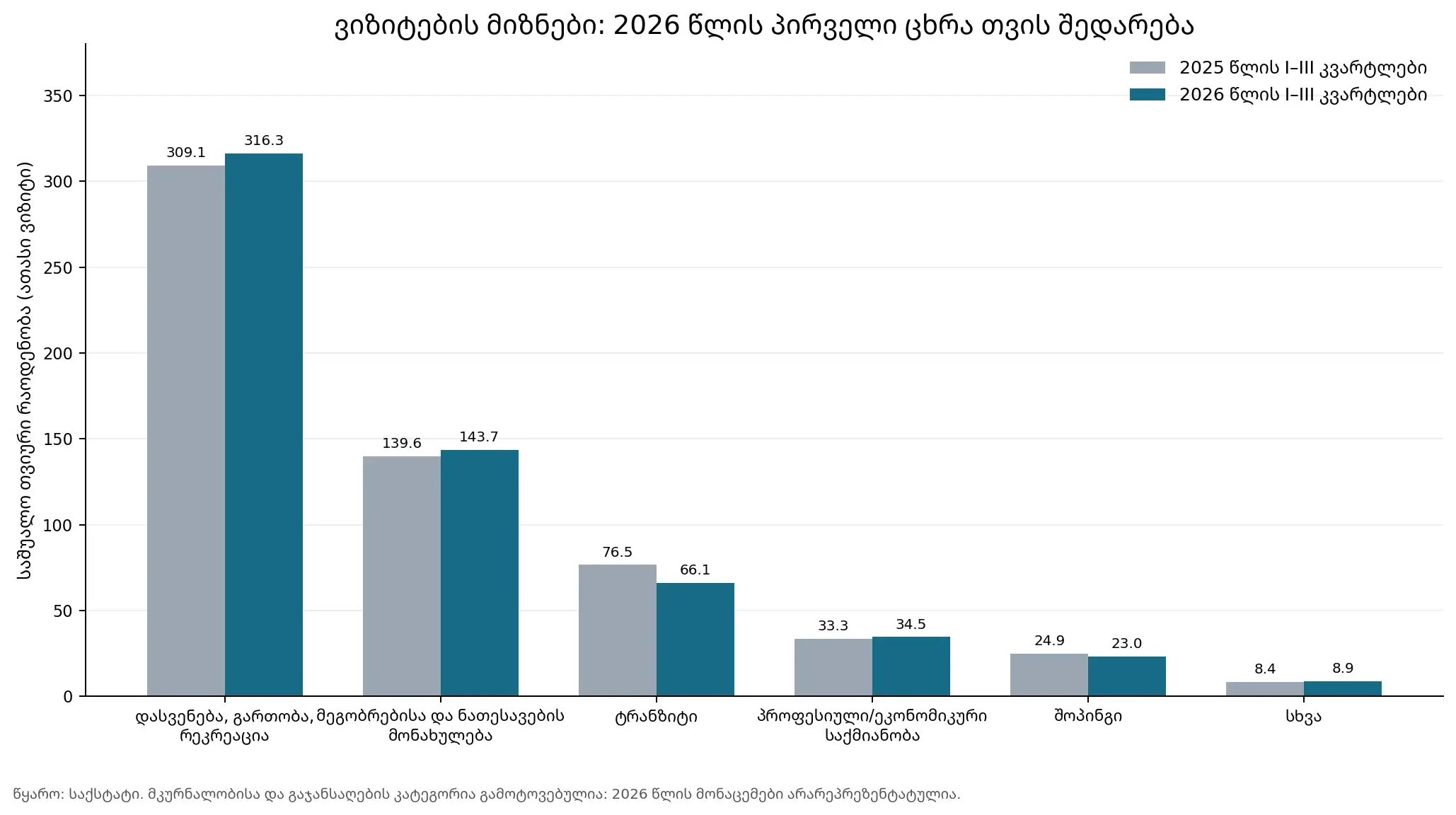
These figures indicate that in 2026, leisure and visits driven by social ties remain the primary drivers of Georgia's inbound tourism market.
Third Quarter: Summer Season Reshapes Visit Purpose Structure
Quarterly data for 2026 clearly reflects the seasonal nature of Georgia's tourism market, including across visit purposes.
Specifically, in the third quarter, the monthly average number of visits for holiday, leisure, and recreation reached 509.0 thousand, accounting for about 58.8% of the total volume. Regarding other purposes, visits to friends and relatives totalled 186.8 thousand, while transit trips stood at 96.4 thousand.
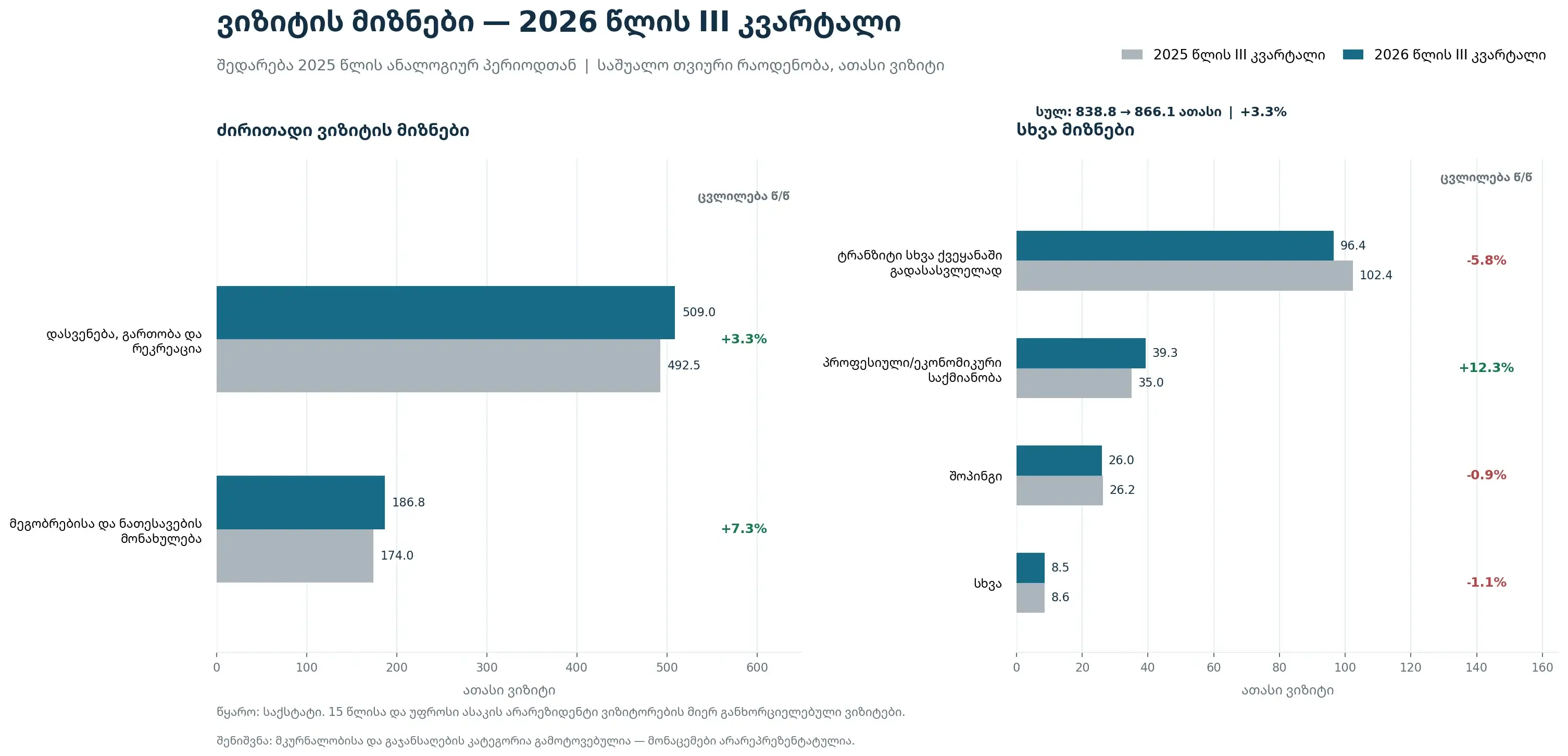
This factor is particularly significant for the tourism industry, as the bulk of demand for holidays, leisure, and recreation remains concentrated in the summer season.
Business Tourism: Significant Potential for Recovery
One notable segment in the 2026 statistics is visits for professional and economic activity.
Over the first three quarters, the monthly average in this category was 34.5 thousand, up 3.6% from the same period in 2025. Moreover, in the third quarter alone, the year-on-year growth reached 12.3%.
Nevertheless, long-term data shows that the business tourism segment still lags substantially behind pre-pandemic levels.
Specifically, in 2019, the monthly average number of business trips stood at 69.3 thousand, compared to 35.0 thousand in 2025. Consequently, the decline amounted to 49.5%.
This situation opens up additional opportunities for Georgia in business tourism, international conferences, exhibitions, and other corporate events. Developing this segment could help smooth the seasonal concentration of tourism demand.
Leisure and Social Visits Exceed Pre-Pandemic Levels
One of the key takeaways from analyzing long-term data is the structural transformation of travel purposes.
In 2019, the monthly average number of trips for holiday, leisure, and recreation was 280.0 thousand, reaching 287.5 thousand in 2025. Thus, the growth was 2.7%.
An even more pronounced increase was recorded in visits to friends and relatives: the figure rose from 122.4 thousand in 2019 to 136.8 thousand in 2025, showing an 11.7% increase.
As a result, in 2025, the combined share of these two categories accounted for around 74.2% of total visits, compared to 62.5% in 2019.
At the same time, the opposite trend is observed across several other segments. In 2025 compared to 2019, transit visits dropped by 28.6%, and shopping trips fell by 35.4%.
Trips for professional and business activity nearly halved, dropping from 69.3 thousand to 35.0 thousand.
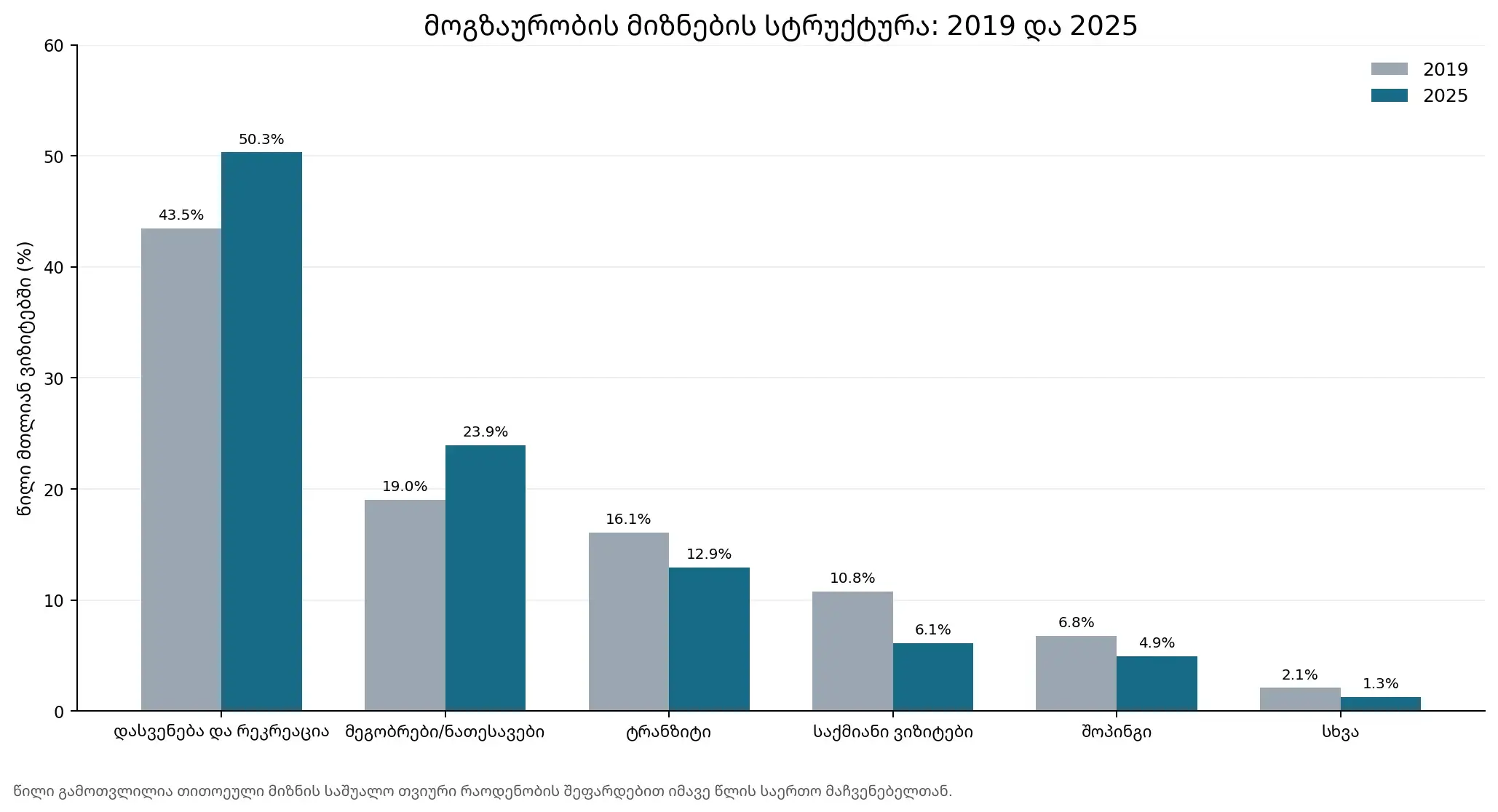
These figures demonstrate that the recovery of the tourism market across various segments is uneven. Leisure and personal visits have already surpassed pre-pandemic levels, while business, transit, and shopping tourism are lagging behind.
What Do These Trends Mean for the Tourism Sector?
A comprehensive assessment of Geostat data yields several key takeaways:
First, Georgia's inbound visitor market is increasingly focused on leisure and recreation. Consequently, developing tourism infrastructure, accommodation facilities, and related services remains a top economic priority.
Second, seasonality in travel continues to pose a major challenge. High concentration of demand in summer highlights the importance of creating off-season tourism products.
Third, the lag in business tourism points to untapped growth potential. Attracting international events and business meetings can serve as an essential tool both for diversifying demand and strengthening the services sector.
Fourth, growth in total visit numbers alone does not signify a full recovery across all segments of the tourism market.
Results for the first three quarters of 2026 show that Georgia's non-resident visitor market is stable in terms of volume, but its structure continues to evolve. Leisure and visits to relatives firmly maintain leadership, while business, transit, and shopping travel offer room for future growth.
Thus, the key challenge for the future development of Georgia's tourism sector is not simply boosting visit counts, but diversifying demand, reducing seasonality, and increasing the economic yield of every trip.