







 Best Citizenship by Investment Programs in 2026
 Airbnb Limits Checkout Chores for Guests
 Foreign Visitors Spent GEL 5.7 Billion in Georgia in Q3 2026
 Russia May End Its IT Mortgage Program Early
 Dublin Warehouse Leasing Jumps 65% in Q3
 Batumi Real Estate Market: Sales Rise as Growth Dynamics Shift — Galt & Taggart
Small Hotel Guests Are Comparing Short-Term Rentals

Short-term rentals are becoming direct alternatives to independent hotels in travellers' booking decisions. In a PriceLabs study released on 21–22 October 2026, 82% of surveyed guests who had stayed in a B&B, inn or small hotel said they would consider a holiday rental at the same or a slightly lower price. Almost half, 48%, would consider switching at precisely the same price. These answers measure stated willingness, not verified cancellations or actual lost bookings.
PriceLabs commissioned a survey of 1,082 travellers across the US, UK, France, Spain and Portugal. The 82% finding applies to the subgroup who had recently used small hotels and similar accommodation, not all 1,082 participants or travellers worldwide. Since PriceLabs sells pricing technology to hospitality businesses, the research is valuable industry evidence but should not be presented as an independent global census.
Small hotels encounter rental competition more often
When asked about an actual trip, 30% of surveyed guests who had booked a B&B, inn or small hotel said they had also considered a short-term rental. Among large-hotel guests the figure was 16%. That narrower measure is distinct from a hypothetical willingness to switch. It indicates that alternative accommodation enters the decision process more frequently for small-hotel customers, without proving which option ultimately secured the booking.
The overlap is greater for longer stays and blended work-and-leisure journeys. Around 30% of travellers on mixed work-and-holiday trips weighed both accommodation types, as did 25% of those booking one- or two-week stays. Access to kitchens, separate work areas, space for multiple guests and the total trip cost can matter more as duration increases. The survey does not provide a verified count of hotel bookings lost to rentals.
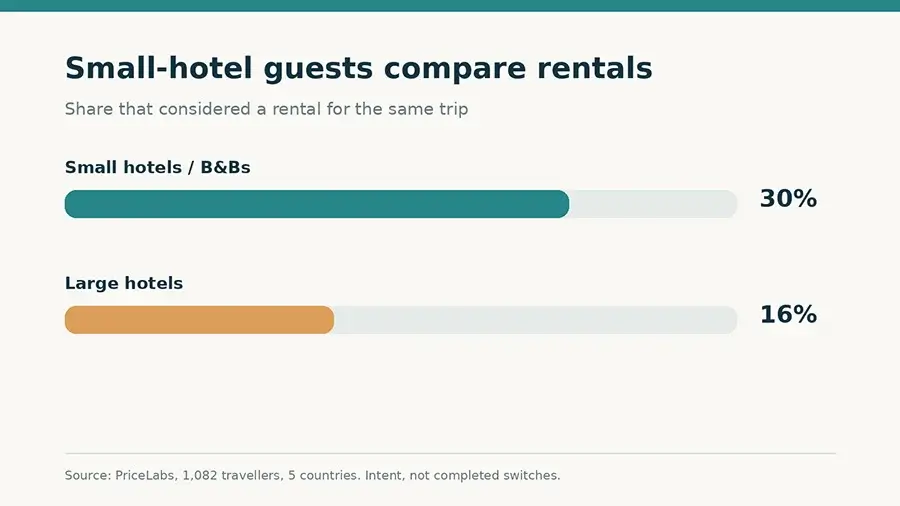
Comparison for the same trip: 30% of small-hotel and B&B guests considered a short-term rental, versus 16% of large-hotel guests. Interest is not the same as completed switching. Source: PriceLabs, 1,082 travellers in five countries. ALT EN: bar chart comparing accommodation choices.
Booking channels place hotels and rentals side by side
The platform used to research a trip can change which alternatives appear in front of a prospective guest. Of respondents using Booking.com, where hotel rooms and rental homes are presented together, 45% compared both formats. The share was 29% among respondents booking directly with accommodation providers. Those are different groups of travellers; the figures alone cannot demonstrate that Booking.com caused the difference.
For independent hotels, a competitor list restricted to properties with similar star ratings may miss what guests actually evaluate. Room size, access to a kitchen, cancellation terms, cleaning requirements and final all-in price can shape the decision. Major chains can emphasise consistency and loyalty benefits, while a small operator has to explain its distinctive service proposition more clearly.
Hotel and rental rates move together in Spanish markets
PriceLabs also compared the daily median rates of hotels and short-term rentals over twelve months in Barcelona and Mallorca. The reported correlation was 84% in Barcelona and 94% in Mallorca, with both categories often increasing prices around peak dates and easing them during quieter periods. Correlated price movements do not mean that a hotel room costs the same as a rental or that the owners of each asset earn equivalent profits.
International Investment's examination of European short-term rentals recorded expanding bookings alongside tighter city regulation and uneven local conditions. PriceLabs' traveller survey complements those market statistics by showing how consumers compare different forms of accommodation, but the two datasets cover different periods, markets and measurements.
What this means for property investors
Holiday rentals and hotels compete for some of the same guests but operate under different cost structures and legal requirements. A hotel typically carries labour, communal facilities and professional operating costs, while a rental home may face different staffing, maintenance and permitted-use obligations. Headline nightly prices and occupancy are therefore not a substitute for net cash flow and property-level risk analysis.
International Investment's wider analysis of travel revenues in 2026 described how higher prices can support spending even as physical demand slows. For an independent hotel or branded hospitality property, the new PriceLabs findings reinforce the need to assess all-in guest costs, local competitors and the quality of management. The five-country survey contains no data from Georgia, so it cannot be used to forecast customer switching or returns in Batumi or Tbilisi.
Frequently Asked Questions (FAQ)
Did 82% of guests abandon hotels? No. They said they would consider a rental at a comparable price; actual switching was not measured.
How large was the PriceLabs survey? It included 1,082 travellers from the US, UK, France, Spain and Portugal.
How often did small-hotel guests compare rentals? For the same trip, 30% considered a rental, compared with 16% of large-hotel guests.
Does a high price correlation mean equal hotel and rental rates? No. Barcelona's 84% figure measures co-movement, not the price level or investment return.